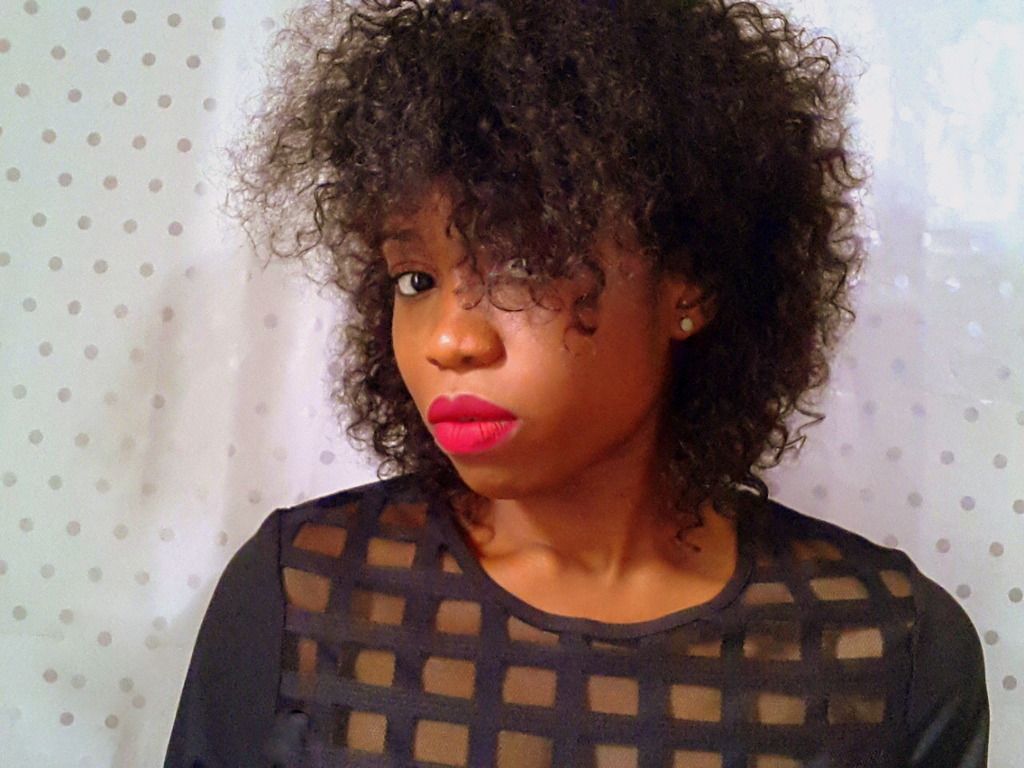
Blackhairstory is an open letter to African-American women about the relationship that they have with their hair. Here, you will find articles, product reviews, photos, stories and more.
To add your name to this letter and become a contributing author, email blackhairstory@gmail.com

I think about what it would mean for black people to fully embrace the many different textures of their hair. I imagine sitting on a train and not seeing any weaves, wigs or processed styles. I imagine us telling our women that they are beautiful. I am an idealist.

widget by BloggerStop

Tuesday, February 17, 2009

Moved to wordpress

I have moved to wordpress. The new address is www.blackhairstory.wordpress.com

Tuesday, February 10, 2009

What I am Loving: Janelle Monae's Style


Nominated for a Grammy for "Many Moons" in the Best Urban/Alternative performance category, Monae, who insists that she is "not a Red Carpet gal", commands attention with her elegant coiffe and non-traditional outfit.

Sunday, February 8, 2009

Halle Baldy


I almost killed myself trying to find the remote to turn up the volume, when I heard that Halle Berry was going to shave her head bald for her role in the upcoming film Nappily Ever After. Although Halle won't be wearing her hair for this role, she will be wearing two hats; that of an actress in the film and that of co-producer.

“It’s a movie called “Nappily Ever After” and it deals with this issue of women and their hair,” Berry explained in a recent interview. “As women we define ourselves by our hair. I always have my whole life. When my hair's not right, then I’m just not right and many days I won’t leave the house if my hair is not right. I still struggle with this hair issue," she remarked while pointing out that her character "is forced to look at what beauty is, and it comes from inside...I'm going to get the lesson on film, and hopefully other women will get it, too.We get so fixated on our hair and so this movie is about this woman whose hair gets damaged and she decides in a drunken stupor to shave her head completely bald."

Based on the eponymic novel by Trisha Thomas, the movie promises to explore themes central to the lives of many women. Interestingly, Nappily Ever After is only the beginning of Venus Johnston's hairstory. In Would I Lie to You, Trisha Thomas' character moves across the country and leaves all that is familiar behind her. In Nappily Married, Venus is forced to reconsider her decision to cut her permed hair when she decides to take on a new job.

******************************************************************************************

About the novel:
African-American advertising agency executive Venus Johnston has had enough. Enough of the painful, expensive hours spent relaxing her "good" hair and enough of her four-year relationship with medical intern Clint Fairchild, which has lasted too long without a ring. She shaves her hair to a quarter-inch stubble, tells Clint to pack his bags and spends the rest of Thomas's empowering debut novel building a new life to match the new woman she's become. Clint, on the rebound, meets beautiful, longhaired and marriage-ready Kandi Treboe and proposes on an impulse, despite evidence that he's not over Venus. Meanwhile, Venus confronts issues of sexual harassment and racism in her predominantly white Washington, D.C., firm, where she begins to receive threatening notes. The crisis at work fuels Venus's fears that she's not strong enough to survive her new freedom. Has she made a mistake by abandoning the security of her boyfriend and her long, straight hair? Kandi develops into a complex character, with her own set of concerns and a sense of humor about the lovers' triangle. Her perspective provides an interesting counterpoint to Venus's obsession with the consuming culture surrounding black women's hair. Clint's confusion over his choice between the two women is treated honestly, and Venus's discovery that she has moved to new psychological territory carries emotional weight. This exploration of an African-American woman's journey to self-acceptance is not without flaws (spotty writing and loose ends tied up too fast), but Thomas refuses to let her characters slide into stereotype, and she keeps the pace fast and funny. -Publishers Weekly

Thursday, February 5, 2009

Talking about hair: Just my thoughts


So I'm a graduate student at a PWI (Predominantly White Institution) and the second semester has started. In one of the first sessions for a class that I am taking, the professor asked us to introduce ourselves and talk about a cool new piece of media that has captured our attention or that we absolutely love. (It's a class about designing and producing educational media) Although we all sat in a circle, he called on us randomly. The entire time, before he called on me, I argued with myself over whether I should discuss my favorite program (LOST) or this blog. Remember, this is a PWI. Discussing LOST would be much easier and many more people would be able to identify with me. I opted to talk about my blog and was pleasantly surprised by what happened next.
I told my new classmates that I had very recently created a blog devoted to African-American hair care, and the uniquely political aspects of our hair styles and choices. People seemed genuinely interested and some asked me to share the site, but this wasn't the most surprising part. Right after I discussed the blog, my professor told me that he was recently reading a book about Madame Walker. He asked me, 'Do you know Madame Walker?'. I smiled when he said this and nodded yes. He explained that it might seem weird to me that he is reading a book on Madame Walker but that as a native of Indiana, he  had become particularly interested in hair and hair products because of the variety that are available there and the fact that Madame Walker is from his hometown. I told him that it wasn't weird and that blackhairstory was all of our history, which brings me back to the debate that I was having in my head before I told my classmates about the site.
I was nervous about sharing the site, nervous about appearing radical or afro-centric, nervous about being placed in a black box by my white classmates and professor, nervous that they might visit the site and be totally confused and nervous and that it would just be dismissed. But I believe what I told my professor. Black hairstories are part of American history. It made me so happy that my professor was reading a book about Madame C.J Walker. It also made me realize how we are often engaged in internal dialogues about ways to minimize or diminish our differences. Maybe if we ignored our internal dialogues and started speaking honestly to each other instead, we might be able realize the similarities in our differences and just be ourselves. White students have approached me and talked about how some of the issues on the site resonate with them because they have curly hair that they are compelled to straighten very frequently. What a first class!

Sunday, February 1, 2009

Aunt Jemima's Hair


1889: Rutt and Underwood create an instant pancake mix. Aunt Jemima's image comes out of the logo used on a vaudeville program featuring Black face minstrel comedians. "Aunt Jemima" is a song that they sing during the show.

1893-1980's: Real women are chosen by various owners of the company to represent Aunt Jemima at restaurant openings, fairs, grocery stores and food shows. Ex-slave Nancy Green's (left) likeness is used for the Aunt Jemima logo. Aunt Jemima's head is adorned with a kerchief.

1968: During the civil rights movement, activists threatened to boycott the current owner of the company (Quaker Oats) if they did not change Aunt Jemima's mammyish image and free her from the past. Her headscarf is replaced with a head band and she loses weight.

July 1989: Aunt Jemima trades in her head band for a perm and pearl earrings. Quaker Oats believes that Aunt Jemima's make over shows "Aunt Jemima in a more contemporary light, while preserving the important attributes of warmth, quality, good tastes, heritage and reliability."